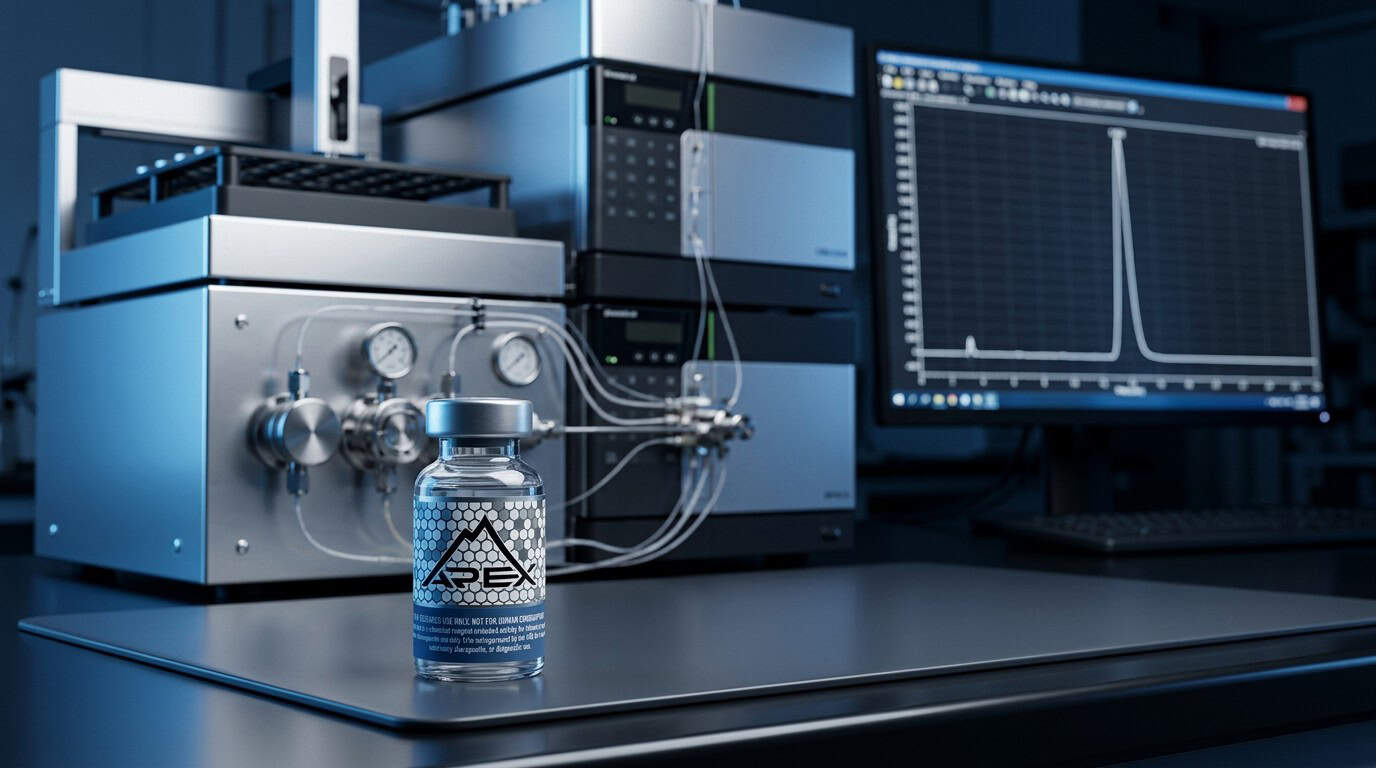
Chemical & Physical Peptide Analysis
Peptide Quality Assurance & Pureness Testing Boc Sciences
It is an area-percent purity dimension, not a total identification or task examination. Notably, pureness percents define chemical structure just-- they do not show sterility or organic viability. Peptides from Maxed Out Compounds are provided specifically for laboratory research study usage and are not meant for human or veterinary functions. Peptide pureness is typically revealed as a portion, such as 95% or 98%. This figure represents just how much of the example is made up of the wanted peptide series. For the majority of laboratory applications, a purity of 95% or higher is considered research-grade.We have the ability of offering consumers from very early peptide medicine exploration phases to peptide analysis. We offer all the technological information and directions for each action of peptide synthesis and evaluation. The release procedure of peptide formulas is complex, and a lack of scientific data impedes advancement. We establish artificial insemination launch models, supplying complete launch contours and kinetic model analysis to optimize item design. One of the most common sources of confusion in peptide jobs is utilizing different top quality terms as if they imply the same thing.

Contamination Troubleshooting
The purity of peptides is generally tested making use of high-performance fluid chromatography (HPLC). HPLC separates peptides based on their communications with a fixed phase, enabling contaminations and by-products to be recognized and measured. Additionally, mass spectrometry (MS) can be used to confirm the peptide's molecular weight and sequence, giving further Peptide Stacks verification of pureness by detecting pollutants and deterioration products. If you've ever gotten a synthetic peptide for a lab experiment, you have actually likely observed a pureness portion on the certificate of evaluation-- commonly values like 95%, 98%, and even 99%. Peptide pureness is an essential high quality metric that tells you what fraction of a peptide example is the intended product versus undesirable by-products.
Discover our brochure to view validated research compounds and learn more about our screening and quality assurance procedure. Even small contaminations can alter outcomes, decrease reproducibility, or present undesirable variables right into a study. Scientists depend upon accurate, verified substances to guarantee their searchings for are both legitimate and constant.Medical Visual Appeals Product Growth
A functional assay determining downstream signaling-- or an architectural research utilizing NMR or X-ray crystallography-- requires the greatest pureness readily available. Crystallographers in particular usually require ≥ 98% pureness since also minor impurities can avoid crystal development or introduce condition into the crystal lattice. As molecules leave the column, they pass through a detector-- typically a UV detector readied to 214 or 220 nm, wavelengths where the peptide bond takes in light highly. The detector records just how much UV light is taken in in time, creating a chart called a chromatogram. This guide breaks down what purity really indicates in peptide chemistry, how it's gauged, what the pollutants are, and just how to review the documents that proves a peptide is what it claims to be.FDA and the European EMA have actually developed standards mandating thorough evaluation and quality assurance for peptide products to ensure security and effectivenessr. In the context of pharmaceutical or clinical-grade peptides, laboratory recognition is indispensable to meeting these guidelines. As an example, before a peptide medication can enter human tests, its producer must demonstrate the identity, purity, strength, and security of the peptide via confirmed analytical methods. Peptide Vendor Peptide pureness screening information are necessary in preclinical studies and need to be included in investigational brand-new medication (IND) applications and later on brand-new medication applications (NDAs).
Peptide Testing: Hplc & Mass Spectrometry Purity Verification
- Every item we carry is lab-tested and verified by third-party partners, so scientists know exactly what they're working with.
- For a deeper identity-focused description, see Mass Spectrometry Peptide Verification.
- A deletion peptide missing out on a solitary deposit may still bind to the very same receptor, yet with different fondness or selectivity.
- Peptides in microspheres and nanoparticles might with matrices, making it tough to divide totally free and encapsulated kinds.
- Laboratory validation of peptides is not only a scientific best technique-- it's often a regulative requirement when peptides are made use of in restorative development or medical research.
- In the end, obtaining the purity degree right implies much more reliable science-- and that's the best objective for any researcher.
As the portion of natural solvent progressively boosts during the run, particles are released from the column in order of their hydrophobicity-- the a lot more hydrophobic a peptide, the longer it takes to elute (wash off). Given that pollutants typically differ from the target peptide by at least one amino acid, they have somewhat different hydrophobicities and appear as separate tops on the chromatogram. The bottom line is not to puzzle purity (HPLC portion of the major peptide vs pollutants) with total content. For experimental preparation (like determining molar concentrations), both pureness and internet material are useful numbers, but purity is what mirrors the chemical homogeneity of the peptide example.